

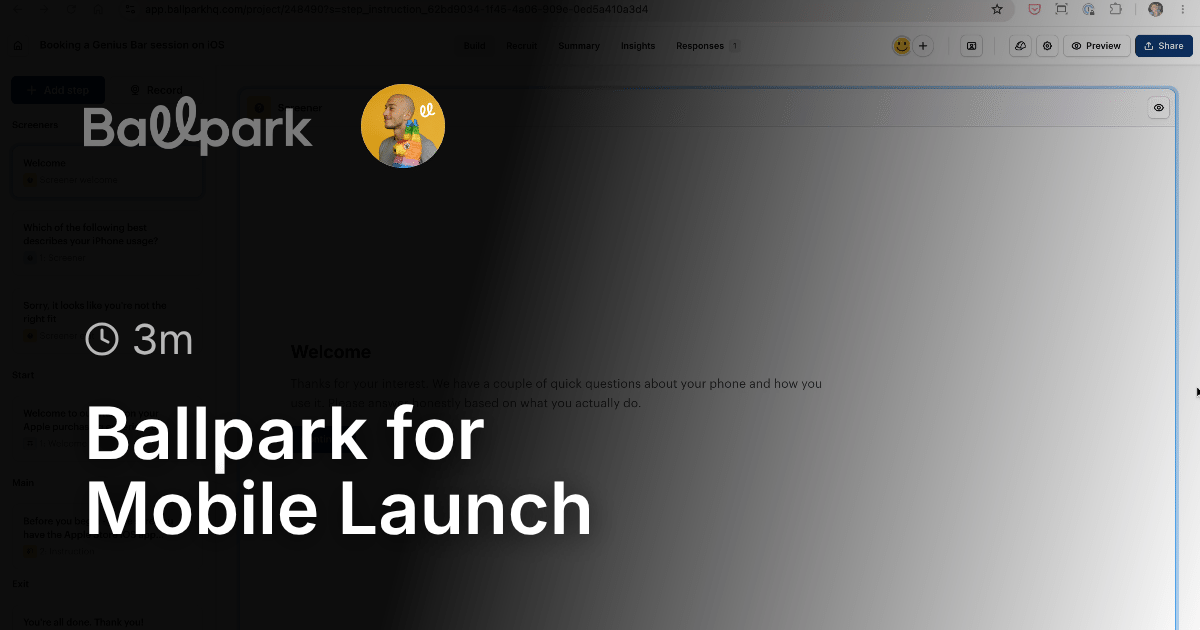
Introducing our most requested feature of the year: a new way to record how your customers use apps, websites and prototypes on iOS and Android.
Mobile browsers don’t support screen recording, which has made it difficult to see how customers actually navigate mobile experiences. That’s why we’ve built Ballpark for mobile.
Participants can now share their screen as they move freely between native apps, websites and prototypes, while Ballpark captures their experience and feedback.
Test your own app, competitors’ apps, live mobile websites or prototypes, all on participants’ own devices and without requiring them to create an account.
What’s included:
Native app testing — See how participants use any iOS or Android app, including your own and competitors’ apps.
Screen and camera recording — Capture participants’ screens and front-facing cameras throughout a study.
Website and prototype testing — Watch participants navigate live mobile sites and concepts built with tools like Figma Make, Replit and Lovable.
AI-powered analysis — Screen recordings are analysed, plus transcripts and feedback with Ballpark’s AI tools.
No participant sign-up — Participants can jump straight into a study without creating an account.
To get started, open any study and go to Build → Record → Screen recording → Collect mobile screen recording or watch the video below for more information.

Workspace owners can now transfer ownership directly from the People page in Ballpark.
Previously, ownership transfers had to be handled by support. That could slow down urgent handovers, especially during offboarding or team changes. With this update, the current workspace owner can transfer ownership to another active member in the product.
To start a transfer, the owner can open the row menu for an eligible member in the People table and select Transfer ownership.
This update is available to all workspace owners on desktop, including SCIM and SSO-managed workspaces.
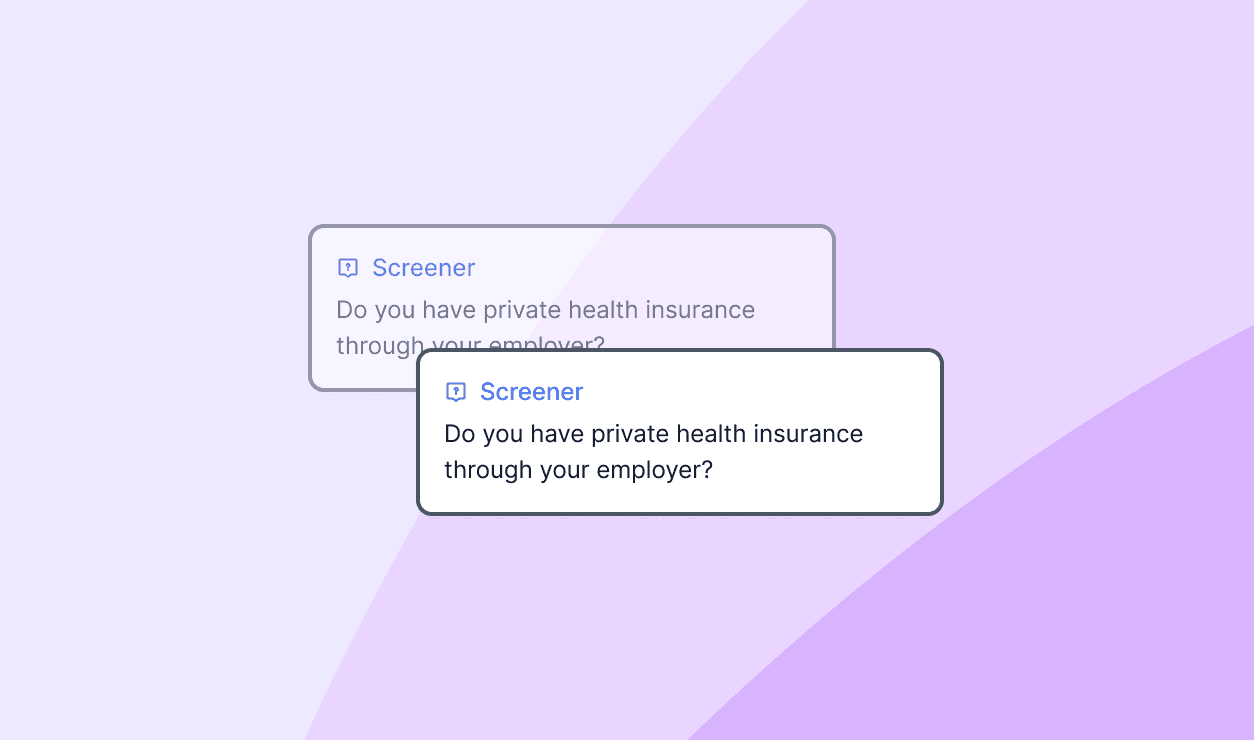
You can now copy steps and questions from one study into another instead of recreating them by hand.
Until now, Ballpark only supported duplicating steps within the same study. If you wanted to reuse a question, screener step, or intro screen somewhere else, you had to rebuild it manually in the new study. That added repetitive setup work and made it harder to keep studies consistent when you were running similar research more than once.
With this update, you can copy a single step from the step menu or with keyboard shortcuts, then paste it into another study as a new step. This works for standard study steps as well as screener steps, and also includes welcome, exit, screener intro, and screener decline screens.
A few rules are worth knowing. Conditional logic is removed when a step is pasted, matching how duplication already works elsewhere in Ballpark. Welcome, exit, screener intro, and screener decline screens replace the existing version in the target study after confirmation. Screener steps can only be pasted into screener sections, and Ballpark still applies the existing 10-step screener cap and active recruitment warning.
To use it, open the step’s more menu and choose Copy, then paste it into the destination study with Paste new. You can also use CMD+C and CMD+V.
This feature is available now.

You can now reuse past recruitment orders to get repeat participant sourcing set up faster.
This is helpful for teams who run similar studies over time and don’t want to rebuild the same recruitment setup from scratch each time. Reusing a past order cuts down on repetitive work and helps keep your recruitment approach consistent across studies.
When you start from a previous recruitment order, Ballpark uses that past order as the basis for your new setup. This is designed for reuse of earlier recruitment work, so you should review the new order before submitting it to make sure it matches the needs of your current study.
How to use:
Go to any study
Click Recruit in the header bar
Click Reuse previous order